Books — how to declutter and organize books
Five steps, twelve joy-check questions —
and an answer to how many books to keep
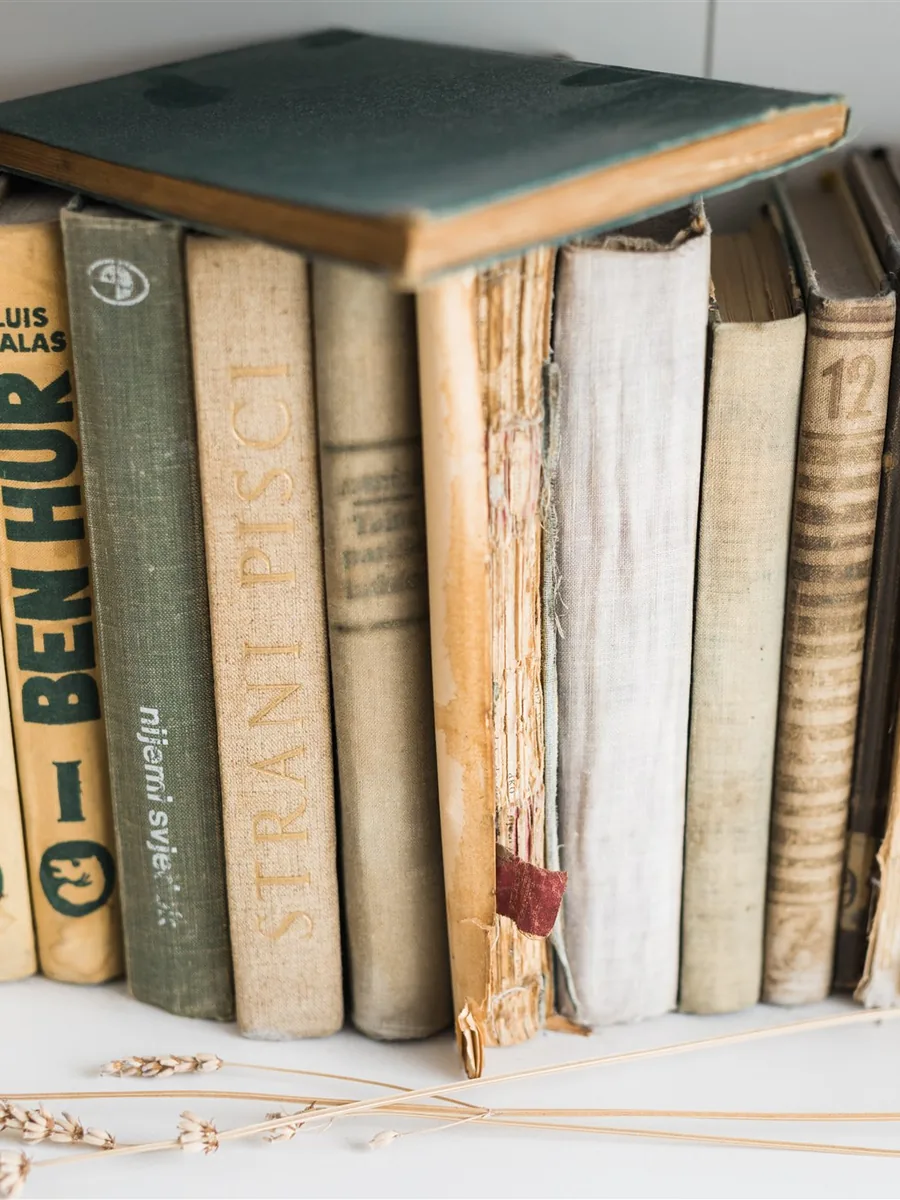
If a book's purpose is to spread the knowledge it holds, then it is happiest when it is in use. So the question is a simple one: do you love this book and need it always by your side, or can you let it go so it can carry on sharing what it knows?
There is no right or wrong answer. Some books we hold on to as though they were the only remaining copy in the world, while others have given us everything they had and can move on.
What we are after is the reading experience. After you have read a book, even if you do not remember all of it, you have already taken it in. It is always the journey, not the destination.
Books are the second category in the KonMari® method, right after clothes.
Five steps to sorted books
Prepare the space and the boxes
Choose a place where you can gather all of your books together. I find stacking them on the floor by subcategory the easiest way, but a table in the dining room or a bed in the bedroom works beautifully too.
Prepare boxes for four destinations: selling, repairing, donating and recycling. When the boxes are standing ready, the decision is not postponed — the book goes straight to its place.
Take every book off the shelves
At first it seems we can decide while the books are still on the shelf. Even so, I urge you to take them all down and arrange them into piles.
It has the shock effect we need in order to see whether every book is really meant to be with us. Beyond that, we have to hold each one to feel whether it sparks joy. And it is no small thing: this is the ideal moment to wipe them down and look at the condition they are in.

Make the pile and wake the books up
As you build the pile, separate it into subcategories:
- general books — fiction, biography, comics
- practical books — textbooks, cookbooks, DIY manuals
- reference and instructional books
- educational and school books
- visual books — art books and coffee table books
- spiritual and religious books
- periodicals, magazines and everything else
Once the piles are ready, it is time to wake the books up. It sounds odd, and why not give something new a try? Books that have stood untouched for a long time are dormant and almost invisible, which makes it harder to decide whether they stay or go. Wake them by clapping your hands, or by running your fingertips gently across the piles.

The joy check
Which books speak of your lifestyle? What do you want to see when you look at the shelf?
Take each book in your hands and feel whether it sparks joy. Keep the ones that move you instantly — the ones that bring joy simply by being visible on the shelf.
With series and multi-volume sets you do not have to hold every one. Wrap your arms around the stack and hug it, or hold only the first volume.
Do not start reading the book in your hands, because you will lose yourself in it. The decision is best made in the first few seconds; after that you start thinking about whether you need it, instead of feeling whether you love it. It is still worth leafing through, to see whether photographs, letters or notes were left inside.
Books from your profession are best let go if you have not touched them in a while and believe you will. If you truly need one again, finding it will not be a problem, and there is a good chance you will get fresh, updated information. At the same time, you are passing valuable knowledge on to someone who needs it right now.
Magazines and coffee table books — keep the ones you would never even consider throwing away. They date quickly, so change them often. If a book holds photographs or articles you are particularly fond of, move them into a scrapbook of your own or a folder with plastic sleeves.
Titles and words — when you are done, look at the titles that remain and check whether they fit your ideal lifestyle. Words matter and they carry a certain energy. The situations that keep repeating for us are often connected to the words we hear and see.
Do not feel sad about books you only read halfway. You got what you needed from that first half, otherwise you would have read to the end. Take it as time well saved. The same goes for films. Stopping midway means you are in tune with your intuition when it says: I do not need this, and I do not want it. Our wish to close the circle and finish everything is nowhere near as important. The first is listening to yourself; the second is satisfying society's ingrained drive for perfection.
Books come back. You can let them go without fear. If you ever need one again, it will be easy to find, buy or borrow. Books find us more often than we find them, so even what we missed will return.
If the decision is hard, these questions will guide you through the joy check:
- Why did you buy this book, and do you still need it for that reason?
- Which feelings are you strengthening by keeping it at home?
- What role does this book play in your life?
- Do you carry the information within you after reading it?
- Where would you look for that information if you did not have the book?
- If it is a book for entertainment, would you read it again?
- Do you want that knowledge to stay with you through the changes in your life?
- Does it fit into your ideal lifestyle?
- Is its possible future use worth as much as the space it takes up?
- Would you buy it in a bookshop today?
- When you have little time to read at night, would you reach for this one?
- Does reading this book feel like a chore, or do you look forward to opening it?

Thank the books you let go. This is the last and important part of the joy check. At some point that book brought you joy, knowledge and a beautiful experience of reading, and with that it fulfilled its purpose. It also helped you recognize whether you like a similar subject and style of writing, and what bothered you about them — the shape, the colour, the way it was written, the genre. If you forget to thank each book as it goes, hug the whole box and say thank you.
Books are the category where letting go is hardest
A free 20-minute call is the easiest first step. We go through your situation, with no obligation at all.
Storing books

How to store books
- A traditional bookcase or shelf.
- Repurposed boxes, if you do not have enough shelving.
- By subcategory, in the part of the home where you use them — cookbooks may stay in the kitchen, instead of all books living together.
- Standing upright fits more in, and you are still free to lay them down if there is room. Arrange them however suits you: by category, colour, height or author.
How many books to keep
Keep only the books you love most. The number does not matter — there can be a hundred of them, as long as every one belongs on your top shelf.
That said, having fewer books has a stronger effect on the quality of information. Once you are left with only the ones that make you happy, the quality of what comes your way changes noticeably. You will soon notice that the information you need appears at the exact moment you need it, because the space you freed by letting books go makes room for an equal amount of new information.
Questions that keep coming up
Do I really have to take every book off the shelf?
You do, and it is the part most people try to skip. While books stand on the shelf they are dormant, and we are looking at spines rather than books. Only when you take them down and hold them do you feel whether a book sparks joy — and the pile on the floor shows the real quantity, which the shelf never does.
What about books I have not read?
Ask yourself whether you look forward to reading it or whether it feels like an obligation. If it has stood there for years and you have not reached for it, you probably will not next year either. Books come back: if you ever need it, it will be easy to find, borrow or buy.
What about professional books I might need?
If you have not touched them in a long time, it is best to let them go. Every field moves on, and when you really need the information you will get something newer and more accurate than a book that has stood for years. At the same time, that knowledge goes to someone who needs it right now.
Do all the books have to live in one place?
They do not. The basic rule says to declutter by category, but when it comes to storage books may live where you use them. Cookbooks in the kitchen, manuals by the desk. What matters is that each subcategory has a place of its own and goes back to it.
Shelves full and decisions stuck?
Books carry memories and plans, which is what makes them heavy. Book a free 20-minute call and we will look at where to start, together.